Lower bills, more comfortable homes, cleaner energyA guide for Swanage residents
Compiled by the Purbeck Energy Group, part of Sustainable Swanage
This guide aims to help local residents who want to lower their energy bills, lower their exposure to price volatility and create a warmer, drier home.
Everything on this page is a service, grant or contact you can use from Swanage, Wareham, the Purbeck villages and wider Dorset. Most of it is free.
Start here: three free ways to see where you stand
None of these commits you to anything, and between them they will tell you almost everything you need to know before you spend a penny.
Check what your home needs
The free Dorset Homewise tool asks a few questions about your property and gives you a tailored list of improvements, in a sensible order. It takes about ten minutes.
Healthy Homes Dorset gives free, impartial energy advice to anyone in Dorset, whatever your income. They help with high bills, damp and mould, storage heaters, smart meters, grants and switching supplier.
0300 003 7023
Monday to Friday, 9am to 5pm. Or text ADVICE and your name to 07984 440584 for a call back.
See it for yourself
Dorset Greener Homes opens real homes to visitors, so you can ask the owner what they spent, what worked and what they'd do differently. This year's open days are 17, 18, 24 and 25 October. Many homes are open by appointment all year round.
The first two steps cut how much energy you use. They cost little or nothing and they show up on your next bill. The second two change where that energy comes from, using less fossil fuel and paying back over a longer stretch.
Plenty of Swanage homes have already had the loft done and the draughts sorted. If that's yours, you're not starting at the beginning. You're starting at step three.
The order matters because each step makes the next one smaller. Insulate before you size a heat pump and you'll need a smaller, cheaper unit that runs better. You don't have to do all four, and you don't have to do them in one go.
Which step are you on?
The pale numbers are the two steps that cut what you use. The solid ones change where your energy comes from.
1 Waste less
Already done if there are no obvious draughts, your thermostat and radiator valves work as they should, and a combi boiler is set to around 55°C.
Already done if your loft has roughly 270mm of insulation and any cavity walls are filled. Not sure? A LEAP home visit or the Dorset Homewise tool will tell you, both free.
Talking to an installer? Our list of questions to ask covers insulation, heating, hot water, solar, batteries and tariffs, with a plain reason for each one. Print it and take it along.
What the bigger jobs cost
All the money in one place, so you can judge for yourself. Solar is the cheaper purchase outright. It is the Boiler Upgrade Scheme that flips it, and there is no equivalent grant for solar.
Typical costs for a family home, before and after grant
Costs from Energy Saving Trust. Checked July 2026.
12
Steps 1 and 2. Waste less & insulate
Free and low cost
Draught-proof the obvious gaps first: letterbox, loft hatch, floorboards, unused chimneys. It's the cheapest thing you can do and you feel it immediately.
Turn the boiler flow temperature down to about 55°C if you have radiators and a combi boiler. Most are set far too high. Your rooms stay just as warm and you use less gas.
Get your heating controls right. A room thermostat, a timer and thermostatic radiator valves working together will save more than any gadget.
Join your supplier's Priority Services Register if you're over State Pension age, have a disability or a long-term health condition. It's free and brings extra support from your supplier and network operator.
Ask your supplier about the Warm Home Discount if you're on a low income.
Free local help
Five routes to impartial advice, none of which will try to sell you anything.
These schemes pay for insulation as well as heating, so they belong to steps one and two as much as step three.
Grant schemes change often. We check this section regularly, but always confirm the current position before you commit to anything.
Every scheme below checked July 2026.
Dorset Warm Homes: Local Grant
Fully subscribed · waiting list only
Funded by government, managed by Dorset Council and BCP Council, delivered by Ridgewater Energy. It pays for insulation, heating upgrades and renewables in qualifying homes. You may be eligible if you own your home or rent privately, your EPC rating is D to G, and one of these applies: household income under £36,000, someone in the household receives a means-tested benefit, or you live in a qualifying postcode. Only a small number of Purbeck postcodes qualify on area alone, so check.
The scheme is currently fully subscribed. New applicants go on a waiting list with no guarantee of funding. It's still worth registering. Details and a postcode checker at dorsetwarmhomes.co.uk, or call 0300 003 7023.
The current scheme runs to March 2028. From 2027/28 it merges with the Warm Homes: Social Housing Fund into a single scheme for low-income households, delivered by area. The detail of that successor scheme has not yet been published.
Healthy Homes Dorset insulation grants
Open now
Free cavity wall and loft insulation for households where someone is over 65, has a health condition, is pregnant or has a child under five. Call 0300 003 7023.
Lendology low-interest loans
Open now
If you don't qualify for a grant, Dorset Council partners with Lendology, a not-for-profit lender, on low-interest home improvement loans. See Lendology loans for Dorset residents.
What's coming
Not open yet
The government published its Warm Homes Plan in January 2026: £15 billion of investment, upgrades to up to five million homes by 2030, and a new Warm Homes Agency that will become the single front door for advice from 2027. It also includes a low-interest loan scheme for solar, batteries and heat pumps, and minimum energy standards for rented homes by 2030. Most of the detail is still being worked through. We'll update this page as schemes open.
3
Step 3. Upgrade your heating
Swapping a gas, oil or LPG boiler for a heat pump is the biggest single cut most homes can make to their fossil fuel use. It is also the step with the most public money behind it.
£9,000off a heat pump for off-gas-grid homes on oil or LPG, from 21 July 2026
£7,500off an air source or ground source heat pump for everyone else
Boiler Upgrade Scheme
Open now£9,000 uplift: 21 July 2026 to 31 March 2027
A government grant taken off your quote by the installer, so you never handle the money. It covers £7,500 towards an air source or ground source heat pump, £5,000 towards a biomass boiler and £2,500 towards an air-to-air heat pump.
From 21 July 2026 the heat pump grant rises to £9,000 for eligible off-gas-grid homes currently heated by oil or LPG, running until 31 March 2027. A lot of homes around Corfe, Studland, Langton, Worth and Kingston fall into exactly that category. Check the Boiler Upgrade Scheme rules on GOV.UK.
Find out whether your roof would suit solar panels. The Homewise tool gives a first answer, and any MCS certified installer will do a proper assessment.
If you already have solar, look at whether adding a battery would pay. Cheap overnight tariffs mean a battery can save money even without panels. Dorset CAN's battery storage webinar explains when it stacks up and when it doesn't.
Register your interest in group buying.Switch Together, formerly Solar Together, pools households across Dorset so vetted installers bid for the work as a batch. Rounds open periodically, so register through Dorset Council even if one has just closed.
There is more support available for schools, village halls, churches, sports clubs and businesses than there is for households.
Dorset Community Energy
A not-for-profit Community Benefit Society that funds solar on schools, hospitals and community buildings through local shareholders, then shares the savings. Over 30 installations so far, saving communities close to £1 million on bills and avoiding more than 2,000 tonnes of CO2. It also runs a Community Fund for Dorset organisations.
Free energy advice and grant funding for businesses, charities and community groups in the Dorset Council area, covering LED lighting, insulation, solar and heat pumps. It has supported nearly 400 businesses and more than 100 community groups, saving over 16,000 tonnes of CO2e and installing 12.8MW of capacity.
Up to £1 billion behind locally owned generation. A Community Fund, and a Partnership Fund for councils working with community energy groups, are expected to open during 2026. If your organisation has a site in mind, register an expression of interest.
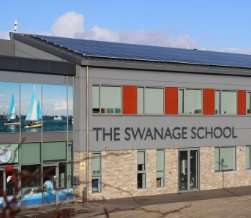
The solar panels on Swanage School were installed in 2016 by Dorset Community Energy, funded by a community share offer with most investors living in Dorset. The school pays less for its electricity, the shareholders get a return, and all maintenance and insurance is covered by the society.
It's the clearest local proof that community-owned energy works, and it's the model we'd like to see repeated on more Purbeck buildings.
Know a Swanage home, business or community building worth writing up? Tell us about it and we'll add it here.
Finding an installer you can trust
This is the question we get asked most, and the honest answer is that no single list solves it. Use two or three of these together.
Check the accreditation
For solar, batteries, heat pumps and biomass, the installer should be MCS certified for that specific technology. Certification for solar does not cover heat pumps. You need MCS certification to claim the Boiler Upgrade Scheme at all.
TrustMark is government-endorsed and covers workmanship and customer service. Buy With Confidence is run by Trading Standards and vets businesses directly. The Green Register lists builders who specialise in low-energy work, useful for older stone-built properties.
Ask people who've used them
Dorset Greener Homes surveys its open home hosts every year and publishes what they said, good and bad, with star ratings: solar and batteries (PDF) and heat pumps (PDF). Several firms named serve Purbeck from Poole, Wimborne and Ferndown.
Before you sign anything
Get three quotes, and get them in writing.
For a heat pump, insist on a room-by-room heat loss survey. A quote produced without one is a warning sign.
Ask what happens if something goes wrong in year three, and who you ring.
Before you sign, take our list of questions to ask. It starts with quotes, grants and references, then goes job by job.
Living in a listed or older building?
Much of Swanage town centre and the Purbeck villages sit in a conservation area, and stone-built, solid-wall properties need a different approach from modern housing. The Sustainable Traditional Buildings Alliance has free guidance written specifically for older buildings.
For anything that changes the external appearance, check with Dorset Council planning first. Most solar installations count as permitted development, but conservation areas and listed buildings are exceptions.
Accreditation registers and installer surveys checked July 2026.
Engage with the Purbeck Energy Group
Tell us what we've missed
This page gets better when people who live here add to it.
Had work done, well or badly? Tell us who, and what happened.
Run a local business that does this work? Send us your accreditations and the area you cover.
Made changes to your home you'd be happy to show people? Dorset Greener Homes is always looking for hosts.
Know of a village hall, church or business roof that would suit solar? That's exactly the kind of lead we need.
PEG has been going since 2020. We bring together people from Swanage, Wareham and the surrounding villages, from complete beginners to engineers with decades in the industry. We're small, friendly and always glad of new members.
We ran Solar Streets Swanage, which brought 90 enquiries and 21 solar installations, and raised £1,150 for a community fund. We used that fund to produce an energy-saving leaflet delivered to more than 11,000 Purbeck homes.
Whether you have a little time or a lot, we'd like to hear from you.
Energy is one part of what we do. Sustainable Swanage also runs the Repair Cafe, the Community Pantry, Greening Swanage, Plastic Free Swanage and our transport work.
We're volunteers, we don't sell anything, and nobody pays to be listed. To keep this page useful we only include services that are live, and free or genuinely low cost to residents; installers and trades holding relevant accreditation, MCS for renewable technologies and TrustMark, Buy With Confidence or The Green Register for wider building work; businesses that actually serve the area and can say so; and listings we can confirm, and which we recheck at least once a year.
We signpost, we don't duplicate. Where Dorset Council, Dorset CAN or Citizens Advice already do something well, we send you to them. Being listed here is not a recommendation from us, and we can't take responsibility for work carried out. Please do your own checks.
Last checked: July 2026
Grant schemes change. If you spot something out of date, please tell us. Funded by Swanage Town Council.