

Cut waste, cut costs, help the planet A Sustainable Swanage guide to local repairs and recycling
To quote Sir David Attenborough “Avoiding waste is the one thing we can all do to help save the planet”. Every bin bag has a cost, in money and in carbon. Repairing, sharing and reusing what we already have cuts both. It means fewer fresh resources dug up, grown or manufactured. Wasting less is one of the simplest ways to save.
Nonetheless, we still throw away huge amounts. The average Swanage household throws away just under one tonne of stuff every year*.
Here’s Dorset Council’s most recent analysis** of our black bins:
- Food is the single biggest thing we throw away at 19% of the bin. 55% of that was avoidable, meaning it could have been eaten, and one in five discarded food items was still in its packaging.
- Sanitary waste is the second largest category at 16%, unusually high compared with national figures.
- Plastics make up 17% of the bin between plastic film and denser plastics, and plastic accounts for two-thirds of all packaging thrown away.
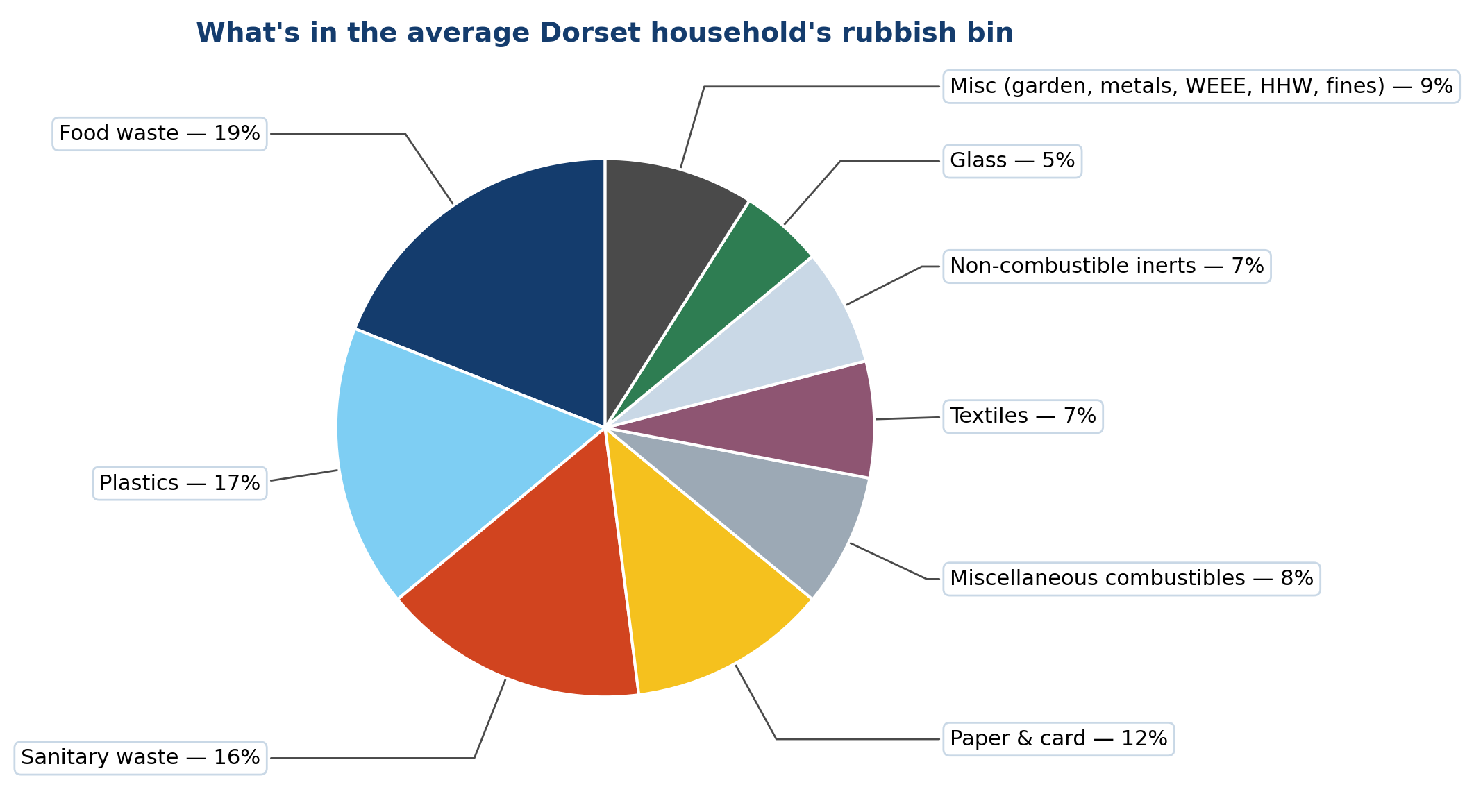
So, what more can we do to reduce waste? The simplest thing is to check that you are using the correct waste bin. Around a third of the contents of an average black bin (32%) are misplaced. They include dry recycling (paper, card, glass, metal cans and plastic bottles and tubs), food waste or garden waste that the existing kerbside collections already accept.
The next section details other options that are currently available. After that, there are details of how you can get involved to reduce waste further.
What you can do now
The 3 steps to reducing waste are, in order:
1. Don’t buy itThe easiest way to cut waste: skip it if you don't really need it
Waste less food
Around 30% of the food the average household buys is wasted. This is worth about £720 per year. Dorset Council provides general advice on how to reduce food waste here.
Surplus food initiatives
To help residents keep surplus food out of the bin and access good food affordably, Swanage has pop-up larders, a food bank, a community pantry and cooking classes. More details here.
Refill and reuse
Cut packaging before it reaches your home.
- Country Food Health Foods & Delivery allows you to bring your own containers to stock up on eco-friendly cleaning liquids, laundry detergents, shampoos, and loose wholefoods like nuts and oats. 37 Station Road, Swanage.
- A free public water refill station has been installed on Shore Road, near the Information Centre.
2. Fix it, or pass it onStill useful? Mend it, lend it, or give it to someone who will
Fix it
It's surprisingly easy to fix things that have stopped working or are broken.

Swanage’s repair café is a community event where volunteers help people fix broken household items like clothes, small appliances and bikes, so things are repaired and reused instead of thrown away. It reduces waste, shares practical skills and creates a friendly space for people to learn how to repair their belongings together.
What it repairs
- Small electricals — toasters, lamps, radios, kettles
- Clothing and textiles — tears, zips, buttons, and general mending
- Furniture — chairs, drawers, stools and similar wooden pieces
- Bikes
- Jewellery and ornaments
- PAT testing and general fixing advice, alongside the hands-on repairs
Volunteer fixers
- Around 30 volunteer fixers registered with the group
- Typically 10–12 turn out at each monthly session
- New fixers are always welcome, and you don't need to be an expert. If you can sew on a button or change a plug, you can help.
Repair rates
Approximately 2/3rds of items brought to the Repair Cafe are fixed.
Meetings
- The 3rd Saturday of every month, Herston Village Hall (check Facebook first)
Pass it on
Someone nearby probably wants what you don't. If an item still works but you no longer need it, let it have a second life locally.
- Freecycle Purbeck passes unwanted items free to neighbours who want them.
- Swanage's charity shops, including the Emporium, take clothes, books, toys and household items.
- Dorset Reclaim collects and rehomes furniture.
3. Recycle itOnly once it's truly done. Put it in the right bin
A comprehensive, A to Z listing of recycling options in Swanage can be found here. The options include:
Kerbside collections
These cover more than you might think. Dorset Council collects a wide range of materials at the kerb. It's worth checking the list, because putting the right things in the right bin makes a real difference.
Swanage Recycling Centre
The Household Recycling Centre at Prospect Business Park takes most things the kerbside collection can't, from batteries and paint to furniture and mattresses.
Opening hours on the Dorset Council website
Recycle around town
If it's not practical to get to the Recycling Centre, there are shops and drop-off points that can help you recycle. Several town businesses take specific items: the Co-op collects soft plastics and crisp packets, pharmacies take unused medicines, and Frith Opticians takes old spectacles. Check the list here.
What we're working on
Library of Things
The Repair Café is currently investigating the practicalities of setting up a Library of Things. If you have any previous experience of setting up or running a library, or would like to volunteer, please contact repaircafepurbeck.chair@proton.me.
A Library of Things is a community-run lending service that allows members to borrow tools, appliances and equipment for a nominal fee or free of charge, rather than purchasing them. Operating on a circular economy model, it helps residents save money, reduce household clutter, and minimise environmental waste by sharing items that are typically bought for one-off tasks or infrequent use.
Common items available in a Library of Things include:
- DIY & home improvement: cordless drills, sanders, jigsaws, tile cutters, step ladders, stud finders, wall chasers, and socket sets.
- Gardening & landscaping: lawn mowers, hedge trimmers, garden shredders, pressure washers, leaf blowers, rotavators, and pruning saws.
- Cleaning & home maintenance: carpet cleaners, steam mops, commercial dehumidifiers, thermal imaging cameras (to check home heat loss), and drain rods.
- Events & hosting: pop-up gazebos, trestle tables, folding chairs, projectors, projection screens, PA speakers, fairy lights, and large catering equipment (hot water urns, punch bowls).
- Camping & outdoor leisure: tents, sleeping pads, car roof boxes, portable camping stoves, cool boxes, stand-up paddleboards, and outdoor yard games (giant Jenga, boules).
- Hobbies, crafts & kitchen appliances: sewing machines, overlockers, musical instruments, specialised baking tins, food dehydrators, pasta makers, and ice cream makers.
Sustainable Swanage
Our steering group was first set up to win Plastic Free Town status for Swanage, under the initiative run by Surfers Against Sewage. In July 2019 we became the fourth town in Dorset to achieve it, and have made good progress since. The Town Council prohibits the use of single use plastic across all the events held on its land including Sandpit Field and Prince Albert Gardens. This includes more than 100 events each year.
However, there is still much to do. So, we are looking for volunteers to join our project team. Examples of initiatives include helping local businesses cut single-use plastics, and helping residents deal with the surplus re-usable plastic bags they have accumulated. There is a link to the national Plastic Free campaign here.
Get involved
Whether you have a little time or a lot, we'd like to hear from you.
Become a fixer at the Repair Cafe
If you can mend clothes, toys or simple electricals like kettles and toasters, come along to an event for a chat. You don't have to make every meeting.
A few hours per event.
Join Sustainable Swanage's campaign against single-use plastic
Contact us at hello@sustainableswanage.uk if you would like to take part in our plans to engage with businesses and residents in the town.
Tell us what's missing from our A-Z recycling listing
Know a shop or scheme that takes something our where-to-recycle list doesn't cover? Every addition makes the guide more useful for the whole town.
Email: hello@sustainableswanage.uk
Share your ideas for reusing and making do
Using up and being creative with what you already have is a skill worth spreading. If you have tips, tricks or projects that keep things out of the bin, we'd love to share them.
Whenever inspiration strikes.
Tell us what we've missed. Is there something you can't find a way to recycle locally? A repair skill you'd like to learn or teach? This page gets better when people who live here add to it.
Elsewhere on this site
Waste is one part of what we do. Sustainable Swanage also runs Greening Swanage, the Community Pantry, our energy work and the travel and transport group.
All our projects · Volunteer with us · Warmer homes and cleaner energy · News and events · hello@sustainableswanage.uk
About this page
We're volunteers and we don't sell anything. We list services that are running now, and we say plainly where something doesn't yet exist. Where Dorset Council or national schemes already publish good information, we send you to them rather than repeat it.
Collection details and drop-off points change. Always check before you make a special trip.
* Dorset Council: recycling rate and residual waste per household, 2023/24.
** Source: Dorset Council Waste Strategy 2024, Appendix 1 (residual waste composition analysis).