

The nature around us needs a helping hand A Sustainable Swanage guide to what a changing climate is doing to Purbeck’s natural environment, and how you can help protect it
Swanage is surrounded by an area of outstanding natural beauty. Indeed, Purbeck has been described as England’s nature capital. It is remarkably diverse.
Landscapes
Within ten miles of Swanage you can stand on the chalk grassland of Ballard Down; cross the largest lowland heath reserve in the country at Purbeck Heaths; walk the ancient woodland above Corfe; and reach the sand dunes at Studland. Carry on and you’ll find the saltmarsh and mudflats of Poole Harbour, and the water meadows along the Frome.
Wildlife
Each landscape supports different plants and animals. They are home to species that are rare or missing elsewhere in Britain. Dartford warblers sing from the gorse, sand lizards bask on the heath, and nightjars churr at dusk on summer evenings. Every one of the UK’s native reptile species lives in Purbeck, including the elusive smooth snake.
Some animals have come back. Ospreys bred in Poole Harbour in 2022, raising the first chicks in southern Britain for nearly two hundred years. White-tailed eagles from the Isle of Wight now visit the harbour too. And in March 2025 two pairs of beavers were released at Little Sea in Studland.
The BBC’s Springwatch broadcast live from RSPB Arne in 2023 and 2024, and Winterwatch followed in January 2025, bringing our ospreys, deer, hares and reptiles to millions of viewers.
Plant life
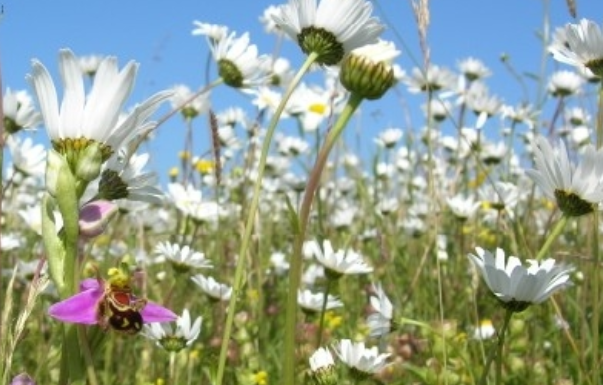
Purbeck contains the 10km square with the greatest diversity of plant species in the country.* The chalk and limestone grasslands make this possible. Thin soils over rock stop any one grass taking over, which leaves room for dozens of smaller plants to share the same ground.
A flower meadow can support 50 plant species in a single square metre. Durlston shows what that looks like: at least 578 species of flowering plant grow in that one small headland, including nine kinds of orchid.**
Protections
Most of this natural wealth is recognised in law. Purbeck lies within the Dorset National Landscape, has many Sites of Special Scientific Interest, and holds National Nature Reserves at Purbeck Heaths and Durlston.
That means most of the land around us is already managed with nature in mind.
The damage being done by climate change
Legal protections are not able to stop climate change and the harm it is doing. They cannot stop a warming sea, more intense storms, a drier summer or a spark in dry gorse.

The habitats around Swanage are already changing, and in some places quickly.
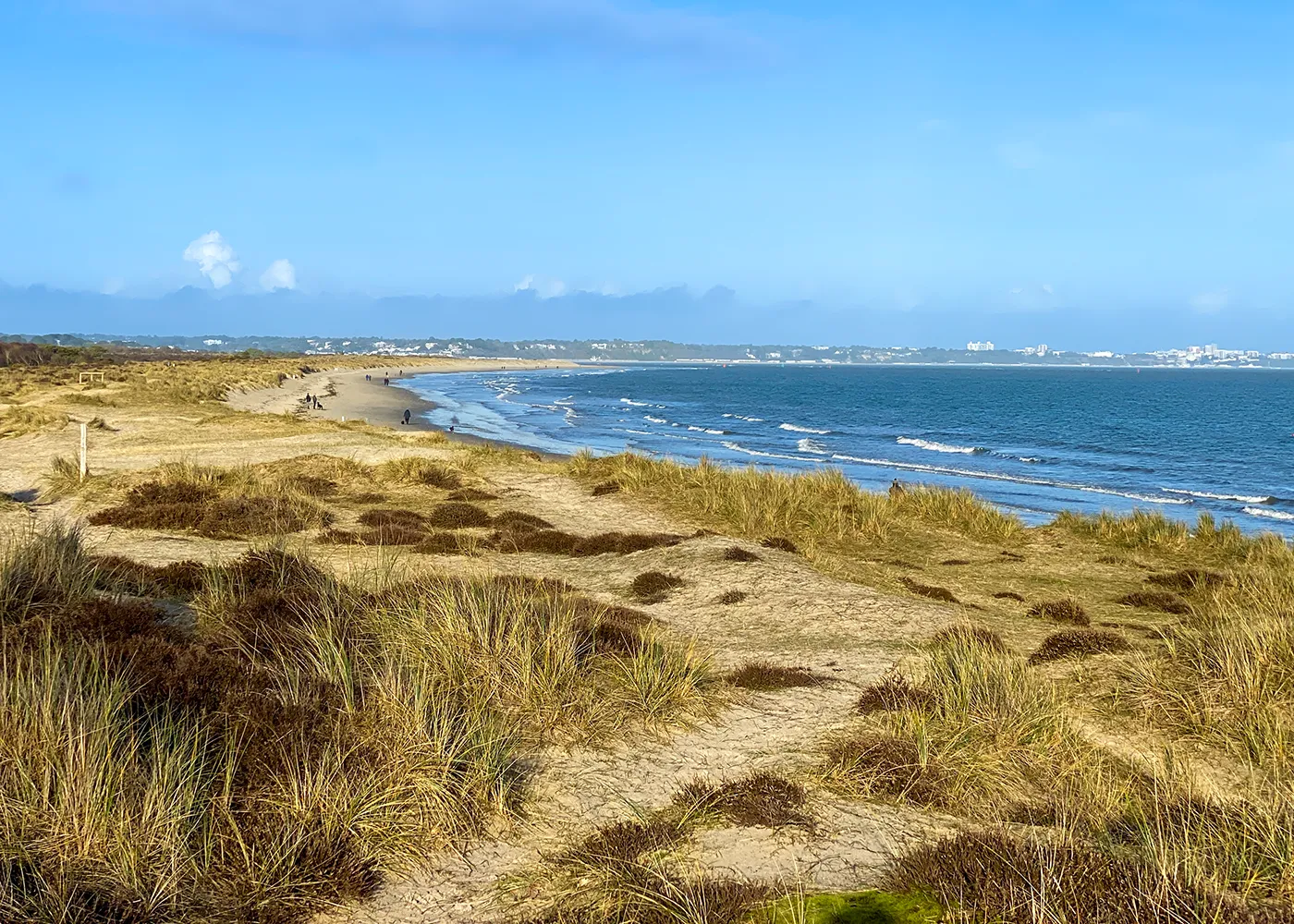 The dunes at Studland are moving inland
The shoreline is retreating by roughly 60cm a year on average, and far more when the weather turns. A single storm surge in 2014 took up to ten metres of dune in one night.
Sea levels around our coast could be around 80cm higher by 2100, which will make storms bite harder.
The National Trust has chosen not to fight this with concrete. Instead it is letting sand move naturally around the bay, so the dunes can roll back rather than collapse.
 The heaths are drying out and burning
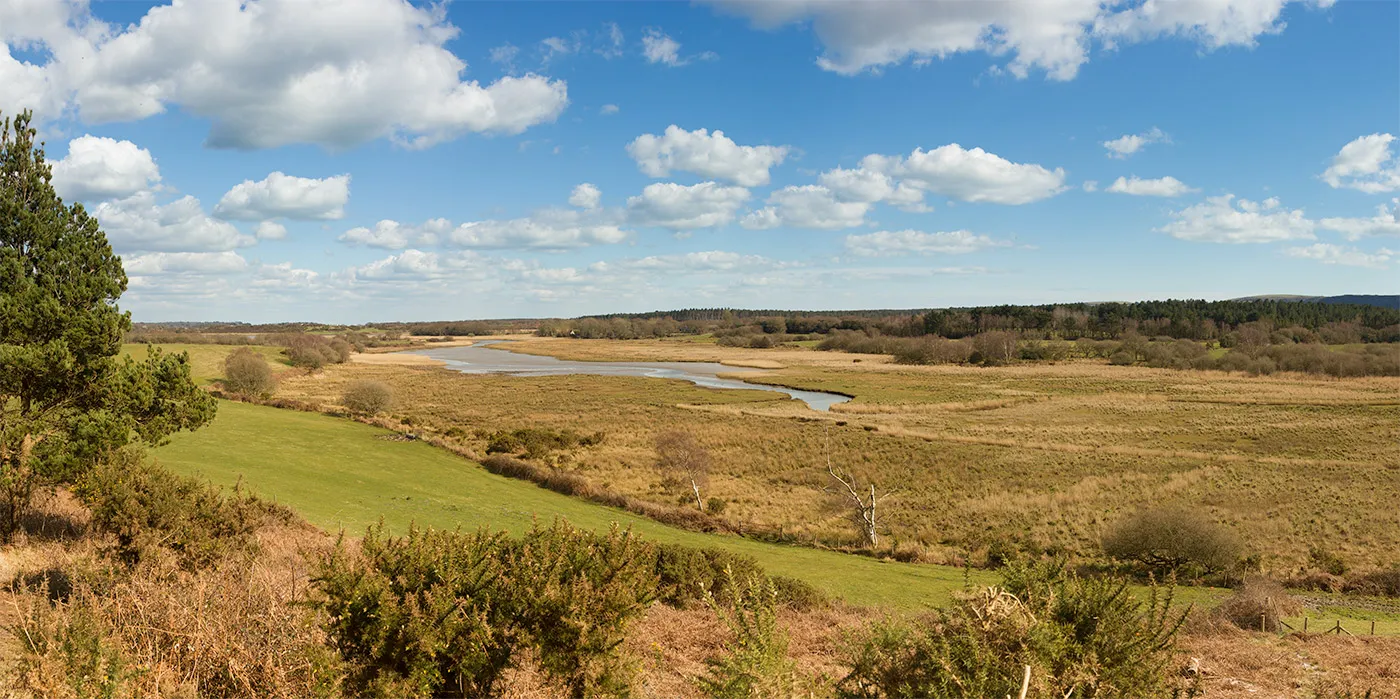
Heathland is at its most fragile in a hot, dry summer. In May 2020 a disposable barbecue started a fire in Wareham Forest that burned around 220 hectares of forest and heath. Reptiles, ground-nesting birds and countless insects died.
Heathland recovers slowly. The structure lost in that fire will take twenty to thirty years to grow back. Hotter, drier summers make fires like it more likely, not less.
 The saltmarsh is being squeezed
Poole Harbour’s saltmarsh has been shrinking for the best part of a century. Rising seas make this worse through what ecologists call coastal squeeze. Marsh naturally retreats inland as the sea rises, but where there are sea walls, roads or houses behind it, it has nowhere to go.
That matters to us, because saltmarsh feeds young fish, holds carbon and takes the energy out of storm waves before they reach the shore.

 The water meadows and valley mires face climate whiplash
Wet grassland along the Frome depends on a water table sitting close to the surface for much of the year. Drier summers pull that water table down and the ground bakes hard. Wading birds lose the soft mud they probe for food, and the plants that need damp ground give way to coarse grasses.
Then the pattern flips. Heavier winter downpours arrive fast off hard, dry ground, so we get floods rather than the slow soaking these meadows evolved with.

Trees are under climate stress
Southern England is the part of Britain most at risk from drought stress in woodland. Beech is especially vulnerable, because its roots run shallow and our thin soils over chalk and limestone hold little water. After repeated hot summers, older beeches show browning leaves and thinning crowns, and some do not recover.
Disease compounds it. Ash dieback has swept through British woods since 2012, and trees already weakened by drought are less able to fight it off.
 Wildlife is falling out of step with the seasons
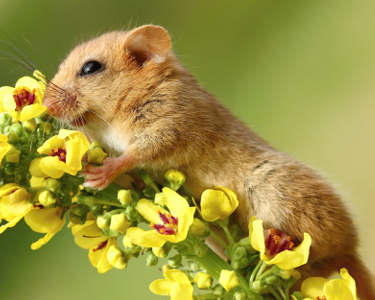
Dormice, bats and hedgehogs are our only true hibernators, and they take their cue partly from temperature. Milder winters wake them early, when their fat reserves are low and there is still nothing to eat.
Newts and frogs face a different problem. They need ponds that hold water through spring, and summer droughts are drying those ponds out before the young are ready to leave.
What you can do now
The map below shows that most of the land within a 10 mile radius of Swanage is owned or managed by public bodies, charities and private estates committed to protecting our natural environment. This means there are plenty of opportunities for you to get involved in their crucially important work. None of them expect you to be an expert or to turn up every week.
Within Swanage
The natural environment within the Swanage Parish boundary is primarily the responsibility of Swanage Town Council. The Council has been working with Sustainable Swanage for the last 5 years to ensure that we appreciate and help nature to flourish.
Swanage Town Council
The Council owns the parks, gardens and playing fields in town. Like every public body in England, it also carries a legal duty (under the Environment Act 2021) to consider what it can do for wildlife and then to set objectives and deliver on them.
The Council has made three specific commitments. It will:
- “manage its parks and open spaces to cope with a changing climate, looking for chances to make them better for wildlife as it goes”,
- “keep increasing the number of trees planted in Swanage” and
- “build sustainability into the design of every new construction project, including the Green Seafront Scheme”
Trees: the target and the reality
The Council aims to plant 30 trees a year, and it has comfortably passed that figure every year. Well over two hundred trees have gone in over the past four years, helped by donations from local nurseries. The Spa now has a second row of trees, diseased trees in Normal Copse have been replaced, and new planting on the Downs is slowly extending the woodland there.
The constraint is not enthusiasm, it is space. A tree needs somewhere it can reach maturity: no services running underneath, somewhere reachable for watering in its first few summers, and not blocking a view that a neighbour will fight for. Losses come from drought, disease, deer, squirrels and, more often than you would guess, vandalism. Planting fifty trees and losing half of them the following summer helps nobody, so the Council plants where a tree will survive rather than where the number looks good.
King George’s is the largest open space in town without tree cover, but it holds five football pitches and doubles as overflow parking, so any change there would need proper consultation first.
Why some grass is left long
If the Downs look shaggier than they used to, that is deliberate. They were once cut regularly and were, in effect, a sea of grass. Now there are butterflies, insects and a widening range of flowers, while mown sections and paths are kept for people to use and enjoy.
The same thinking applies elsewhere. Recent summers have been dry enough that hedges start struggling from July onwards, and some have needed watering. Hedge cuttings are now pushed back underneath the hedge as a mulch, to feed the soil and hold a little moisture in it.
Both changes attract complaints, usually that the grounds team is cutting corners. The opposite is true, and the Council could not make either change without public support behind it. An immaculate, closely mown, golf-course green looks tidy and supports very little. Getting used to something a bit wilder is the single easiest thing any of us can do for wildlife in the town.
Swanage Streams Partnership
The Swan Brook, which runs through the town, is officially classified as failing by the Environment Agency. The Town Council is working with the National Trust, Planet Purbeck and Dorset National Landscape to cut flood risk, clean up the water and bring wildlife back to the brook. You can read more about the project on the Dorset National Landscape website.
The Green Seafront Scheme
The work will stabilise the ground at Sandpit Field, Weather Station Field and the Spa beach huts, where slipping slopes have caused more than fifty defects. Work is expected to start in autumn 2026. More details can be found on the Swanage Town Council website.
Sustainable Swanage
We have set up various volunteer groups that are helping us understand the animals and plants that share our home town.
Why the counting matters. The Council changed how it manages several of its green spaces. The surveys are how anyone can tell whether those changes are working. Volunteers walk the same meadow sections and the same butterfly transects year after year, and the results go to the Town Council — they are part of what keeps the Downs’ Local Nature Reserve status. Wildflowers are recorded twice a year, butterflies along fixed routes through the summer, and a local birder contributes records too.
We are working with the Council to turn several years of this data into a plain-English summary showing what has changed since the mowing regime altered. We will publish it here when it is ready.
 Friends of the Downs
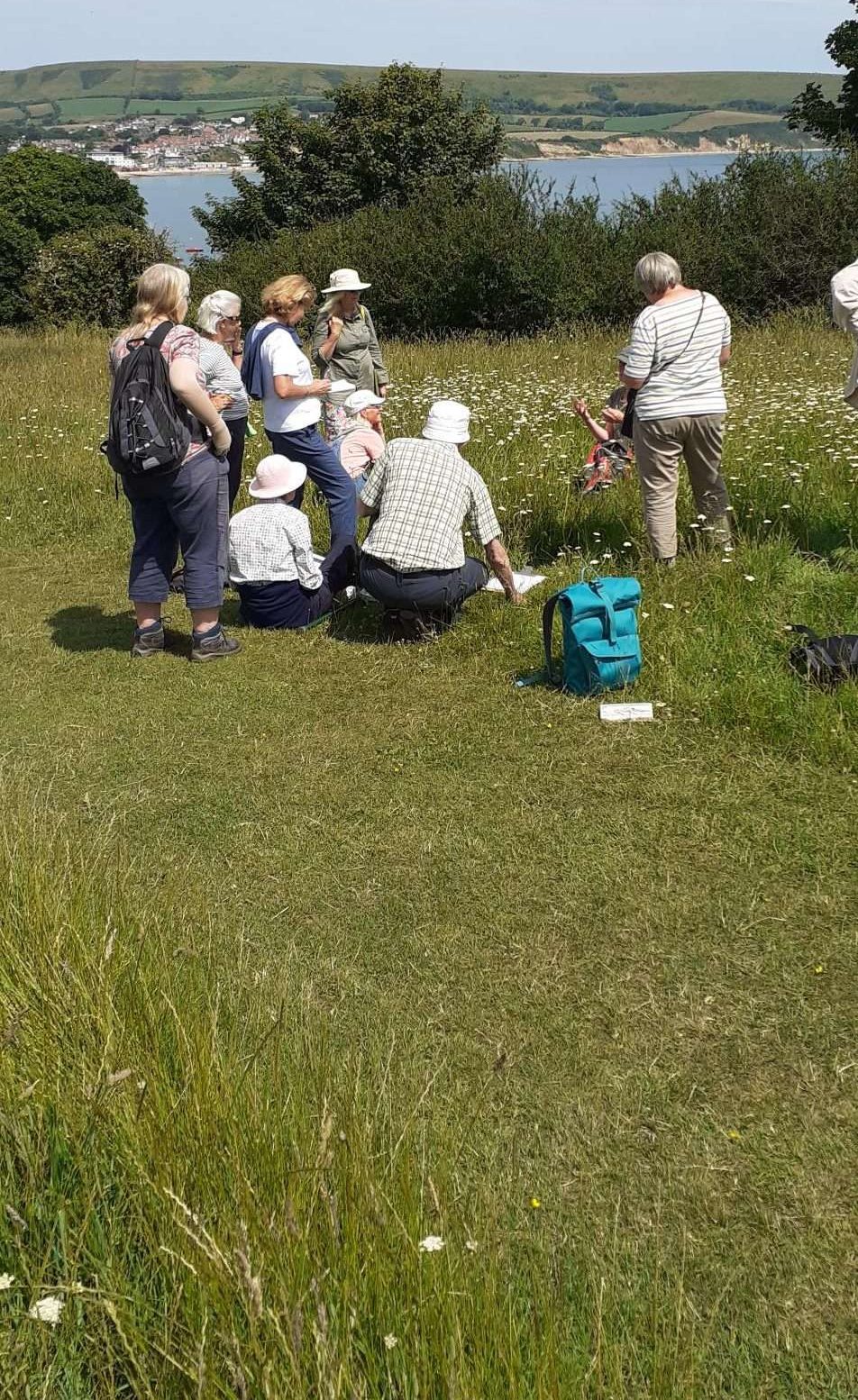
The Downs were designated a Local Nature Reserve in April 2023, after work by Sustainable Swanage in partnership with Swanage Town Council. Friends of the Downs were set up at the same time to carry on that partnership and improve the biodiversity of this important limestone hillside.
The Friends are all volunteers, each specialising in a different part of the picture. They carry out formal surveys which are reported to the Town Council, and those reports are what keep the Downs’ Local Nature Reserve status. The main groups are the wildflower and butterfly surveys, both below.
There is room for more specific groups. We are particularly keen to hear from anyone interested in entomology, the study of insects. Get in touch and we can set up a community meeting with speakers and build a group of volunteers — the Town Council is willing to pay for the training.
Contact: hello@sustainableswanage.uk
Wildflower Survey Group
You don’t need any experience to help record Swanage’s wildflowers. We’ll train you, and you’ll learn alongside others in a small, friendly group. Complete beginners are very welcome.
Set up in 2022 after the success of our butterfly surveys, the group repeats surveys of meadow sections across several sites twice a year. That shows us how changes to mowing and cutting are affecting the flowers. A volunteer expert has compiled the species lists we work from.
Contact: hello@sustainableswanage.uk
 Butterfly Survey Group
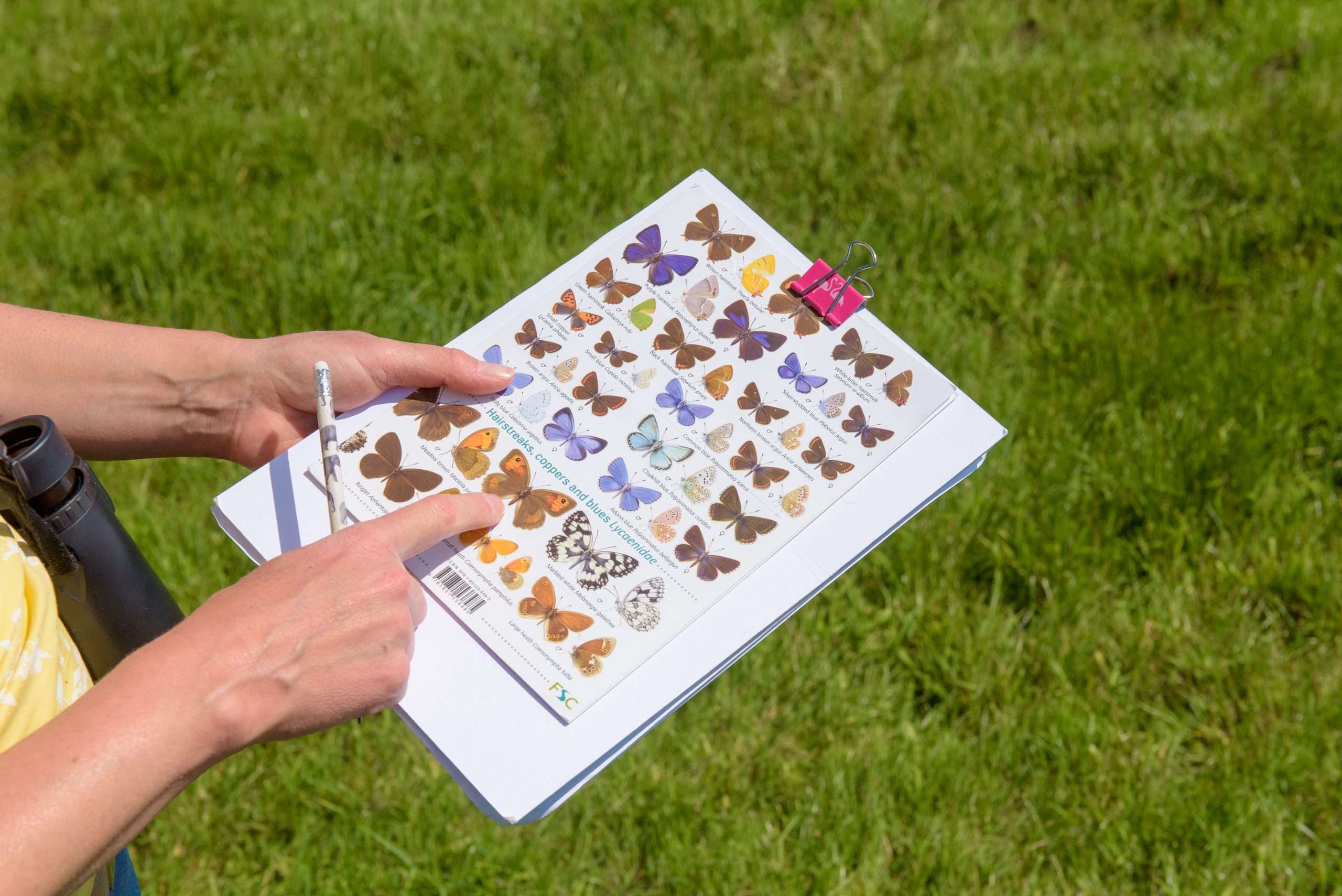
Counting butterflies is one of the most enjoyable ways to help, and it tells us a lot, because butterflies are a good sign of how healthy a habitat is. We set up our training and survey programme to support the Town Council’s goal of monitoring biodiversity on its sites.
Twelve volunteers trained with us in May 2021 and now survey three public green spaces, including the Downs and Prospect Green. Some have gone on to survey other sites in the area. We’re grateful for the support of the Durlston ranger team and the Dorset Butterfly group.
Contact: swanagebeachbuddies@gmail.com · Dorset Butterflies
 Swift Survey Group
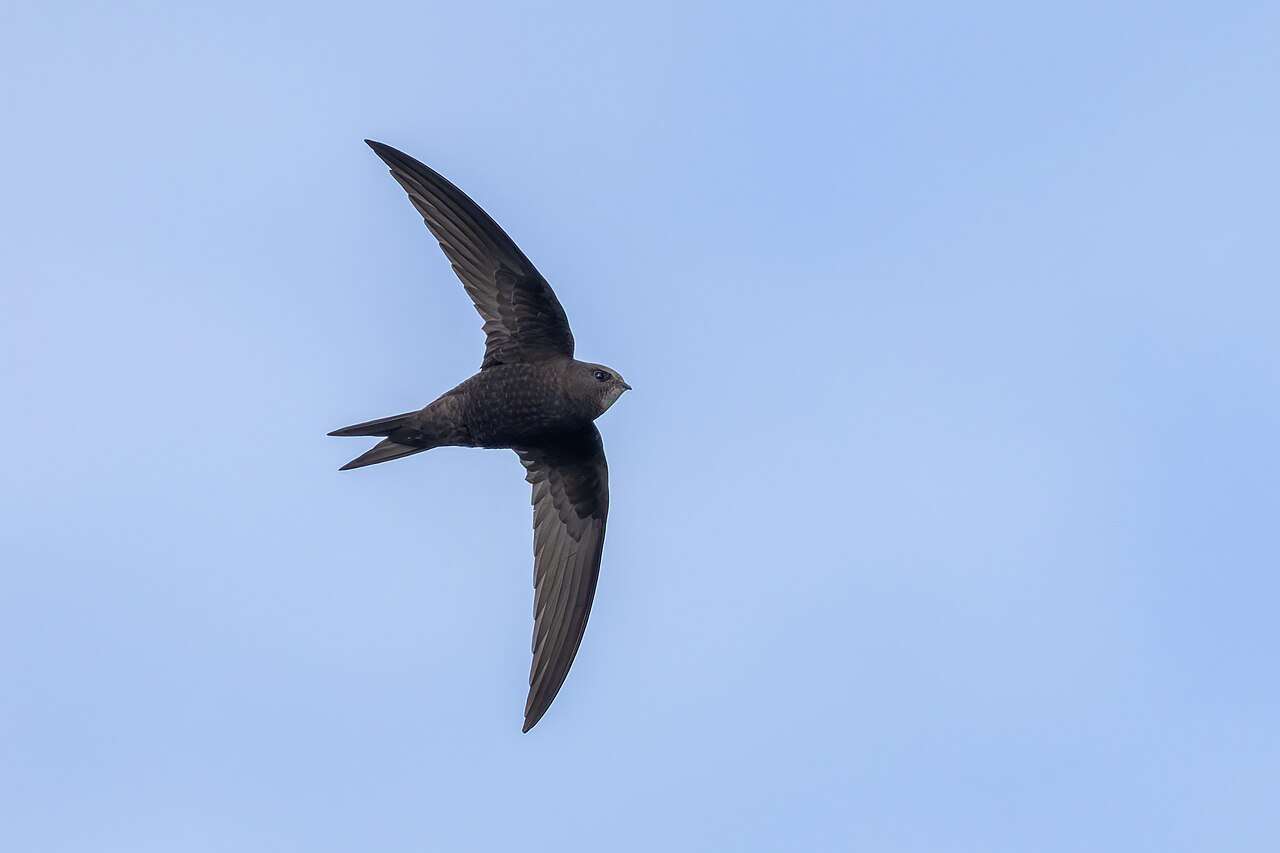
We’re a group of local volunteers protecting the swifts of Swanage and Purbeck, remarkable birds whose numbers are falling. Set up in 2022, we track where swifts are active and map their nest sites across Swanage and the Isle of Purbeck, so we can give them better protection.
We offer free advice and hands-on help putting up swift nest boxes and audio systems that play swift calls to draw birds to new spots. Swifts return to the same nest year after year, so building work and renovations can destroy a nest without anyone realising. We help homeowners spot that risk and find swift-friendly alternatives.
We’re also working for the long term, encouraging local authorities to require swift bricks — nest bricks built into walls — in all new housing.
Contact: swiftresearch67@gmail.com · Facebook group
Get involved
Swanage Tree Wardens
We held a community meeting about trees in March 2026 and the turnout showed how much people here want more of them. The Town Council has adopted the national Tree Warden scheme and is appointing trained volunteer wardens.
Alongside that, our own group is finding pockets of land where residents would like trees, checking who owns them, what lies beneath, and which species would suit. We could be planting this autumn.
What you can do: email hello@sustainableswanage.uk
Green corridors: an idea that needs you
Wildlife needs to move. A hedge that stops halfway along a field, or a garden fence with no gap at the bottom, can be as good as a wall to a hedgehog or a dormouse. Join those green patches up and the whole town works better for wildlife.
We want to map every hedge, verge, garden and green space around Swanage, then find the gaps that matter most and work out how to close them. Ponds could be part of it, giving newts and frogs somewhere to breed as summers get drier.
This one is an intention, not yet a project. We need a small team to get it going, and someone to lead it. If you like maps, or walking with a notebook, or simply know your patch well, that’s enough to start. Email hello@sustainableswanage.uk
Tell us what we’ve missed. Is there a patch of ground near you that could be doing more for wildlife? A species you know is here that nobody has recorded? This page gets better when people who live here add to it.
Around Swanage
These organisations are working to protect the natural environment around Swanage and welcome volunteers.
 Durlston Country Park
Durlston is on our doorstep and more than 150 volunteers already work alongside the rangers there. There are practical work parties with tools and training provided, a Tuesday group restoring the Victorian pleasure grounds, and shifts in the Castle welcoming visitors. Tasks suit all ages and abilities.
What you can do: email durlston@dorsetcouncil.gov.uk or ring the rangers on 01929 424443.
 National Trust
The Trust owns more land around Swanage than anyone else, from Studland and Ballard Down to the coast at Spyway and Worth Matravers. It also runs the Purbeck Beaver Project, which brought wild beavers back to Studland in 2025 after four hundred years.
Volunteers there track individual beavers, check camera traps and record what the animals are changing. Elsewhere the Trust needs help with fencing, scrub clearing, footpaths and welcoming visitors.
What you can do: for the beaver project, email Gen Crisford at gen.crisford@nationaltrust.org.uk. For everything else, search volunteering at nationaltrust.org.uk
 Royal Society for the Protection of Birds
RSPB Arne sits on the western shore of Poole Harbour. It is one of the best places in Britain for reptiles, and the reason the BBC brought Springwatch to Dorset.
Volunteers run the visitor welcome, help on the reserve and take part in surveys.
What you can do: search volunteering at rspb.org.uk and look for Arne.
And something at home
Not everyone wants to join a group, and you don’t have to. Leave a patch of grass unmown until autumn. Dig a small pond, however small. Cut a gap at the bottom of your fence so hedgehogs can get through. Fit a swift brick if you’re building.
Elsewhere on this site
Nature is one part of what we do. Sustainable Swanage also runs the Repair Cafe, the Community Pantry, Plastic Free Swanage, our energy work and the travel and transport group.
All our projects · Volunteer with us · Waste and recycling · News and events · hello@sustainableswanage.uk
About this page
We’re volunteers and we don’t sell anything. We describe what is happening now, and we say plainly where something is still an intention rather than a project. Where the National Trust, the RSPB or Durlston already publish good guidance, we send you to them rather than repeat it.
Sources
* Wild Purbeck Nature Improvement Area, Final Report 2012 to 2015, page 5: “Wild Purbeck NIA is a very special area for wildlife, including the 10km square with the greatest diversity of plant species in the country.” Published by Dorset National Landscape. dorset-nl.org.uk
** Durlston Country Park, Wildflowers pages: “Hay meadows can support an amazing 50 plant species per square metre” and “at least 578 species of flowering plant crammed into this tiny corner of Purbeck”. durlston.co.uk
Other facts used on this page:
- Studland erosion and sea level rise: National Trust, coastal change at Studland Bay
- Wareham Forest fire, May 2020: Forestry England, and Dorset and Wiltshire Fire and Rescue Service
- Poole Harbour saltmarsh decline: studies of Spartina anglica dieback, via SCOPAC
- Hazel dormice, hibernation and population decline: National Dormouse Monitoring Programme data, analysed in Animal Conservation 2023 and reported by the People’s Trust for Endangered Species — a 78% decline between 1994 and 2020
- Woodland drought stress and beech: Forest Research
- Ospreys in Poole Harbour: Birds of Poole Harbour and the Roy Dennis Wildlife Foundation
- Swanage Streams Partnership: Dorset National Landscape
- Beavers at Little Sea: National Trust, Studland Bay
- Green Seafront Scheme: Swanage Town Council and Dorset Council
- Durlston volunteering: Durlston Country Park
- The biodiversity duty on public authorities: section 40 of the Natural Environment and Rural Communities Act 2006, as strengthened by the Environment Act 2021 — see Defra’s guidance on complying with the biodiversity duty