Council buildings · Swanage
Swanage Town Council
In September 2019 Swanage Town Council voted unanimously to declare a Climate and Ecological Crisis and to do its best to become carbon neutral by 2030. Since then, it has taken sustained action to cut the carbon emissions from its own buildings, public toilets, car parks and vehicles. It has been measuring its emissions since 2022, reports on progress every year, and now has a route map to reaching its carbon neutral target.
Progress so far
The council has taken the following steps:
- Green electricity. A fully renewable electricity contract has been in place since September 2023.
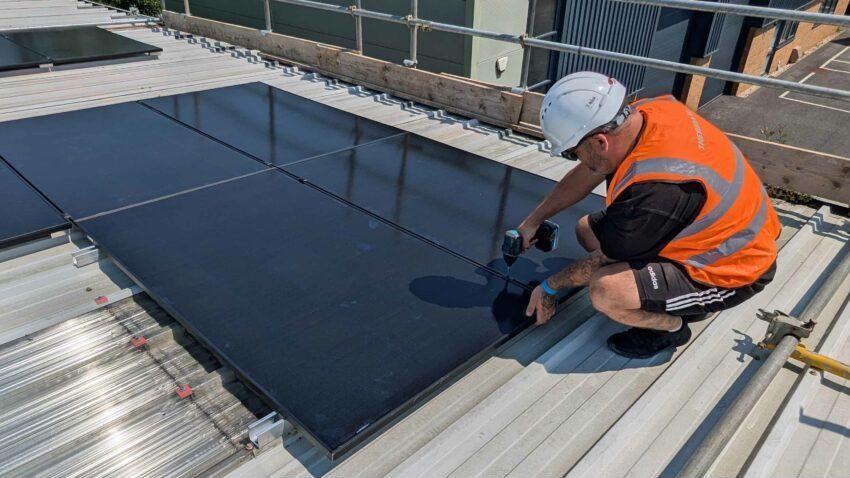
- Solar panels on the depot and the Beach Gardens Pavilion, with a battery at Beach Gardens. Together they generated 29,310 kWh in 2025.
- LED lighting in every council building, and insulation at the Information Centre and Town Hall.
- Electric vehicles: four of the council's seven, plus a gradual move from petrol to electric tools.
Between 2022 and 2025 the council's carbon footprint fell from about 100 tonnes of CO2 to 39 tonnes, a reduction of about 60%.
Next steps
The council's October 2026 route map sets out the rest of the journey to 2030.
- 2026–27: an air source heat pump at the Information Centre (about 3.9 tonnes saved), a more efficient boiler with better controls at the Town Hall annex, more electric tools and more solar stored in batteries.
- 2028–29: replace gas at the depot with electric and add battery storage (about 2.8 tonnes).
- 2029–30: an electric vehicle in place of a diesel vehicle, and bio-diesel for the remaining diesel vehicles, tractor and mower (about 10 tonnes together).
- From 2030: heat pumps and energy monitoring at the Town Hall (about 15.9 tonnes).
That leaves about 3 tonnes a year, which the council expects to offset, for example with tree planting.
The route map is a market-based count, so on a location-based count the council's electricity would still show, and zero would also depend on the national grid continuing to clean up.